Wednesday, 11 March 2015

Work Diary - Sixth Shoot

Evaluation


I enjoyed this shoot because I was able to develop new skills and use different equipment that i havent used before. For instance, I had to take a self portrait, and had to figure out the self timer on my camera. I also used a tri-pod for the portrait part of the shoot so that each image was straight and the model fitted the frame. As i was shooting in the studio, i had to use the big lights for the flashes, and that meant that i had to sync my camera flash to the light boxes. Whilst shooting the 'possession' objects, i used an A3 sheet of paper instead of a table, so that i was able to see what the photo looked like whilst i was taking it, and it was easier for me to position the camera, myself and the objects. I also changed the angle of the light boxes so they were much closer to the objects, which intensified the lighting so that the background (the A3 sheet of paper) was completely white. The only difficulty with this part of the process was that i had to make sure i was taking the photos from the same distance and angle, as i wasn't using a tri-pod for this part. I also had to tie up my hair because it was falling down in front of the lens. Overall, this shoot was completely different to any other shoots i have done, and i really enjoyed co-operating with more people (as i had to use more than one model). 


The images above are the outcome of this shoot. I used various models, including both genders and made sure each person possessed very different objects so that it was clear and obvious, which objects belonged to which person in the photos. I have chosen to include these two images because they are my favourite. This is because in the photo on the left, the positioning of the objects signifies that the model is quite careless, as he hadn't placed his objects in any particular way. Whereas, the photo on the right, shows that the model placed and positioned the objects carefully. We can also see a clear difference between the objects, and the amount that a male carries, and what a female carries. I enjoyed taking these photos, as well as the editing process of putting each portrait with the possessions, and i am pleased with the result.

Progression 

In my next shoot, i plan to use the studio to take portraits of people with their most prized possessions. For instance, I will take a self portrait whilst i'm holding my own camera or my phone. I will also use various models to pose with their most valued possessions which could be a camera, their phone, cigarettes, makeup, glasses etc. This will continue with the possession project, but will allow me to focus on the people themselves rather than just their own possessions. I will also use a similar concept for a location shoot, after i have taken this shoot. I have been influenced by these images from the internet:


Photographer Research - Gabriel Orozco

Gabriel Orozco

I chose to research into Gabriel Orozco's work more because I think it is great influence for my topic, and in most of his images, i can identify evidence. Initially, I chose to research Orozco in further detail because I like the simplicity of his images. His photos show everyday objects, experiences and life which is why they are so so ordinary. However, Orozco's style makes his photos look extraordinary by using an extreme close-up angle, or displaying bright colours within the image. I like the style of Orozco's style and work, particularly the photos he has taken in the street, such as his motor scooter and reflection images. Orozco is a mexican artist and explored different mediums such as painting, drawing, photography, sculpture etc. 


This is one of my favourite photos of Gabriel Orozco's because I like how the background is quite bland and dull-coloured, but the motor scooters are bright yellow, which the background emphasises. I also like the contrast between the graffiti'd, torn, weathered wall against the brand new, shiny motor scooters. The motor scooters are placed in the centre of the image, so that they are the first thing that we see, and then we look at the background and area, where the motor scooters are parked. This is evidence of human presence and civilisation for many reasons, such as the fact that the motor scooters are actually there, as well as the graffiti on the wall.


This photo is displaying clear evidence of human life and presence. In this photo we can see a breath mark on a shiny piano, this indicates that somebody was sat at the piano at some point. I also like the angle of the image as it positions the mark in the centre of the image, so we focus on that to begin with. The shine of the piano is evident because of the reflection from the light. 


This photo signifies many examples of evidence. Firstly, we can see the reflection of trees and the sky in the puddles on the street, which are completely natural and ordinary. There are three different puddles which show different reflections of the trees and the sky. Another piece of evidence in this image is the tire tracks made from the water from the puddles, clearly somebody has ridden a scooter or a bike through each puddle in a cycle, several times which has made the tire tracks. I like the realism and simplicity of this image, as this is a natural and regular occurrence (the puddle and tire tracks). 


This is a photo of two hand prints. I like this image because the background is completely plain and white, which emphasises the black ink which printed the hands, as well as the marks, lines and wrinkles from the hands. I also like this image because Orozco has placed random, black dots around the hands which makes the photo slightly messy, but makes the viewer stare closer to the image. 

Gabriel Orozco's work has influenced my photography for this project as he has used several different examples of evidence within his work, both artificial and natural, such as puddles, handprints, weathering etc. I also like that he takes photos in realistic settings such as in the street and in a house. Orozco has used lots of different techniques and styles for his photography, as he is also an artist of many other mediums. This has given me inspiration to look for different scenarios and examples of evidence within this project, so i am not focusing on exactly the same thing in every photo. Orozco's work is realistic but simple, which i think is effective and would like to use it as influence for my own work. 


This is one of the photos that I have taken in one of my location shoots. This was influenced by Gabriel Orozco's photo of the motor scooters, as I have mimicked the natural and realistic positioning of the motor scooters, with this image of these bikes. Orozco's street photography also inspired me to take more photos within location, of anything which evidenced human civilisation and presence. 


Again, this photo was influenced by Gabriel Orozco's work in his street photography. This photo was taken of a street, with cars parked on either side of the road. This image mimics Orozco's style as he takes photos in their realistic and natural format - likewise with his images of puddles. 

In summary, I think the basis of Gabriel Orozco's work is perfect influence for this topic: Evidence, as he implicitly captures the evidence of everyday life, human presence and civilization. I also like the simplicity of his images. I have already taken photos which relate to Orozco's work, and were influenced by his work anyhow, but I would like to take more simple images in spite of his photography's influence. 

Thursday, 5 March 2015

Work Diary - Fifth Shoot

Evaluation

This shoot unfortunately went very wrong, it was my first attempt at shooting portraits and personal possessions. However, the studio lights were not cooperating with my camera, and the table was too high for me to see what the camera was actually taking. After trying over and over again to fix the issues with the shoot, I managed to produce two presentable images which i could put together, to make one image of a model and their personal possessions. 


These are the two images which i chose out of the entire shoot to produce a final edit. Even though i took many photographs, these were the two which came out the best as the lighting and positioning is correct, whereas in other photos it wasn't.


This is the edit which i produced. I put the portrait of the model, above his possessions. I like this idea because it shows the person, and then it shows his identity through his belongings. So, even though we can see his face, we only really get to know him through his possessions. 

Progression

For my next shoot, I plan to retake photographs for this shoot and make it easier, so that it actually works. For instance, i plan to use A3 white card instead of a table, so that i am able to position the camera easily as it will be the right level. I will also use a tripod to take the portraits, so that the camera stays still and at the same height, and this will make it easier for me to position the camera and zoom appropriately. I plan to take 2 photos for each person, one of them, and one of their possessions. I will then edit them together, like the one above. I aim to do this for at least 5 people. This shoot and the next shoot i complete were influenced by these images which i found on the internet: 


Monday, 2 March 2015

Straight Images - Fifth Shoot


Photographer Research - Laura Letinsky

Laura Letinsky

I've chosen to research Laura Letinsky's photography because I like the simplicity of some of her work. Letinsky mostly uses white backgrounds with white tables or tables with a white sheet over them. This makes the objects laid out on the table stand out a lot more as their colours look much brighter. She also takes photos within a 'house' setting, for instance: in the kitchen. Some of Letinksy's work shows dirty plates, glasses, food, food thats been eaten etc. This makes the photos relatable because the photos are homely and within a setting which everyone can recognise. In some of Letinsky's photos, she only has one or two pieces of food or objects, so they look isolated. This makes them the focal point because everything else in the image is white. 


This is an image that i found of Letinsky's. Like i've said previously, she has used a white background and a table with a white sheet over it. This makes the colours of the balloons, drinks and food stand out. The simplicity of this image is what makes it so extraordinary and interesting to look at because the positioning and particular objects that are displayed begin the questioning of why she did this and why she chose those particular items. This relates to my work, because I plan to use the studio to shoot, with only white backgrounds. 


This is another piece from Letinsky's work, but this one has been taken in a kitchen. The angle of the image is positioned so that we cannot see the objects straight on, but from the side. This allows us to see the floor, drawers and tabletop. Letinsky has also arranged the objects so that they are in the furthest corner from the camera, this makes us look closer into the image, and for longer too. In this photo we can see regular objects that would be found in a kitchen, such as glasses, a tea fowl, food etc. 


I chose to feature this image in particular because unlike Letinksy's other photos, she hasn't arranged the objects precisely and aligned, instead she's either positioned them to look messy, or has taken them in their natural place. I like this image a lot because it's messy, and people can relate to it as it has been taken in a home setting. I also like that this photo isn't all white, as a wooden table has been used. This image displays evidence of human presence because it shows that people have used the glasses, napkins and have eaten the food. 


This image is quite similar because it shows dirty plates and dishes. However, Letinsky has taken this photo in low lighting, so the photo isn't as bright as her other images. We can still see the reflection of the sun shining through the windows and glasses. This photo looks slightly posed because the plates are on the edge of the table and the vase has been placed exactly in the centre of them. I like this photo because it has been taken in natural setting. 

Laura Letinsky's style of photography has influenced me to take photos within the studio, with a completely white background. Her work has also influenced my ideas of taking photos inside and location, of ordinary objects and 'house' possessions. I also like the idea of arranging objects to look messy as well as neat. Although Letinsky's photos look similar to one another, she has used different objects and placements each time. I think these sort of photos would look perfect in a multiple imagery. 


Letinsky's work influenced the concept of this image, as I didn't arrange the objects, and shot the image without any positioning. This allows the photo to show these objects in their natural placement, and also identifies personality traits of the person whose these possessions belong too. In this image, this person can be identified as messy as their desk isn't very organised. This is evidence of human presence as it shows that this desk and the possessions on it belong to someone, and they have obviously put them there. 


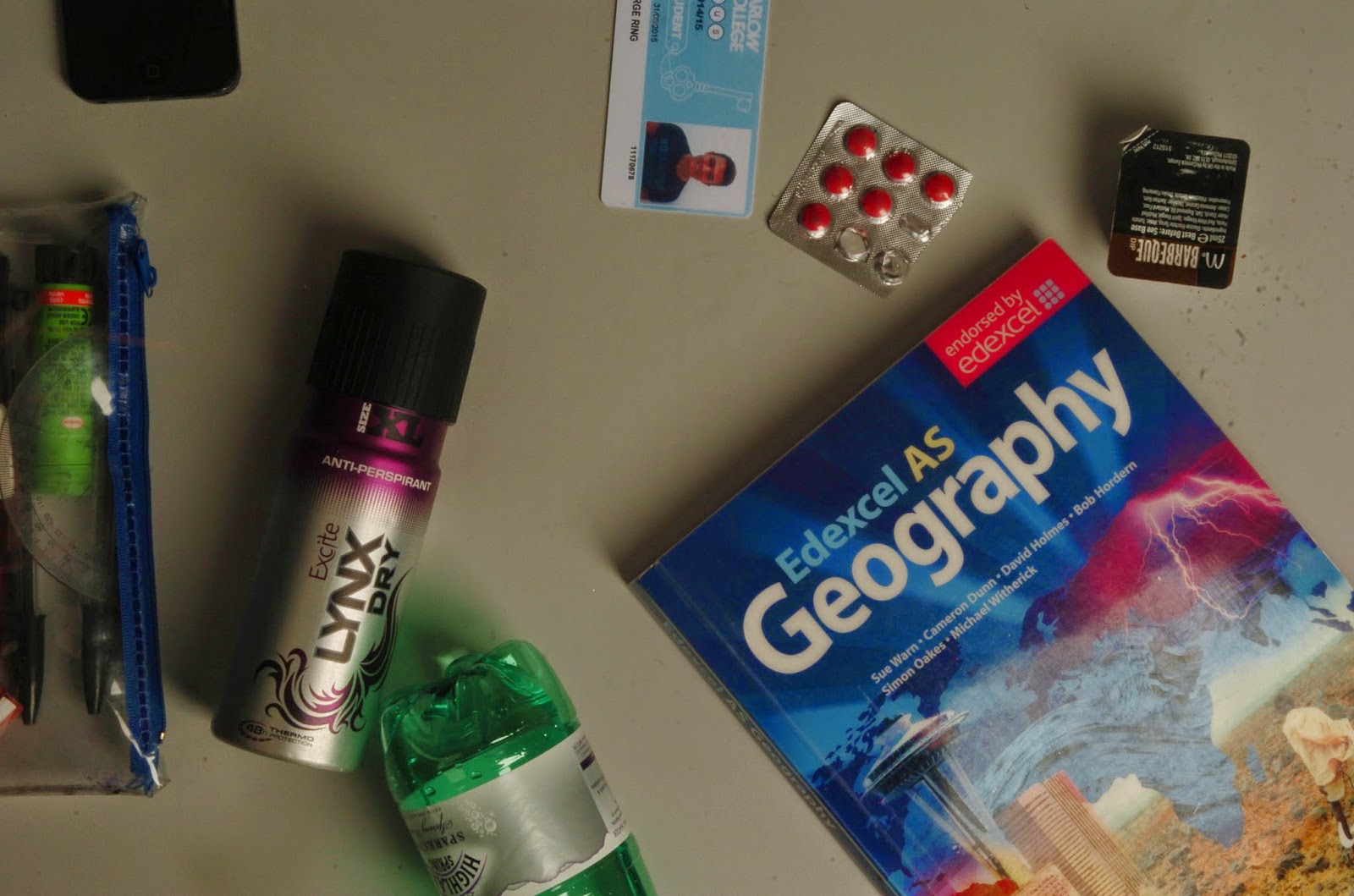
This is another "messy" image that I took in a Location shoot. This photograph was influenced by Letinsky's work because I attempted to capture ordinary, homely objects such as the mug, packet of crisps, carton of orange juice, pens, tablets etc. Again, I didn't manipulate this photo to look neat or tidy, as I took the photo without moving any of the objects. 

In summary, I plan to use the influence of Laura Letinsky's work by shooting in the studio a lot more, using a completely white background to emphasise the focal point in the image. I would also like to use Letinsky's style so that i can capture 'human presence' within possessions, and objects within the home. 

Sunday, 1 March 2015

Illustrated Discussion

Evidence

Evidence is a very broad topic and can be interpreted in various ways. I for one, have chosen to start this topic with the idea "Evidence of Human Presence". This concept will allow me to take photographs of litter, individual's desktops, belongings etc. I would also like to venture into the idea of "Personal Possessions".

However, I could approach the topic from a naturalistic point of view, which would allow me to take photographs of different weather types, i.e. Rain and Sunny. Another aim for this project could be "Crime Scenes". Every time I've attempted to research into Photography of Evidence, the internet produces crime scene and forensic science images. In order to take photos that could link to this approach, i could create fingerprints, shoe prints, vehicle tracks etc., to recreate 'evidence' that could be used during a crime. I personally, would like to photograph the Evidence of Mental Health at some point in this topic, as i have looked into a few photographers that have shot this, and I would like to use their work for influence. Like movement, which could be another approach, we cannot see Mental Illness in reality. However, once i researched into this idea, i discovered many ways in which people have shot, interpreted and and approached it.

On the other hand, Evidence can be approached in a less serious and strict plan. For instance, Evidence can be as trivial as a signature, ID, ash from a cigarette, litter, dirty plate etc. These are all proof of something that has happened. I could even approach Evidence in a comical and ironic way by using crime scene numbered signs or police tape, to signify or cover a dirty plate. This would make my photos more interesting and link two concepts of Evidence into one photo.


Internet Image


This photo on the left, demonstrates the trivial evidence that I mentioned above. This image has been made using two images, one of which is a boy with food smeared around his mouth. The other is a plate of food which matches the stain on his face. This photo shows the evidence of eating food. I like the idea of using two photos in one to create a message.


Internet Image


This photo is a black and white image of a hand, whereby we can see the prints of the model's fingertips. Initially, I thought of the idea of taking photos of finger prints already printed in ink onto paper. However, after finding this photo, I've realised I could also take images of actual fingerprints.


Weegee


Weegee (Arthur Fellig) is a photographer and photojournalist. He is known for his black and white street photography. Weegee shoots real life emergencies, showing the brutality of things that happen in the street. The photo on the left shows a man lying on the street, with blood streaming down the pathway from his head. Obviously, this isn't appealing to look at, the reason I have chosen one of Weegee's photographs is because this is evidence of crime and real-life scenarios.